
These are the Breaks
A meditation on becoming undone

Hello, everyone.
Right now, I’m in a 10-week learning cohort studying the Blues and Jazz traditions as viewed through the writings of Albert Murray, Stanley Crouch, and Ralph Ellison.
I studied Albert Murray’s The Omni-Americans a few years ago and spoke about it on a few podcasts. In the text, Murray richly declares that America is fundamentally mulatto, mixed, and composite, and that what makes America possible is a skill that musicians, writers, comedians, and the Fool in Tarot embody: knowing how to play on the breaks.
Now, I know what you might be thinking:
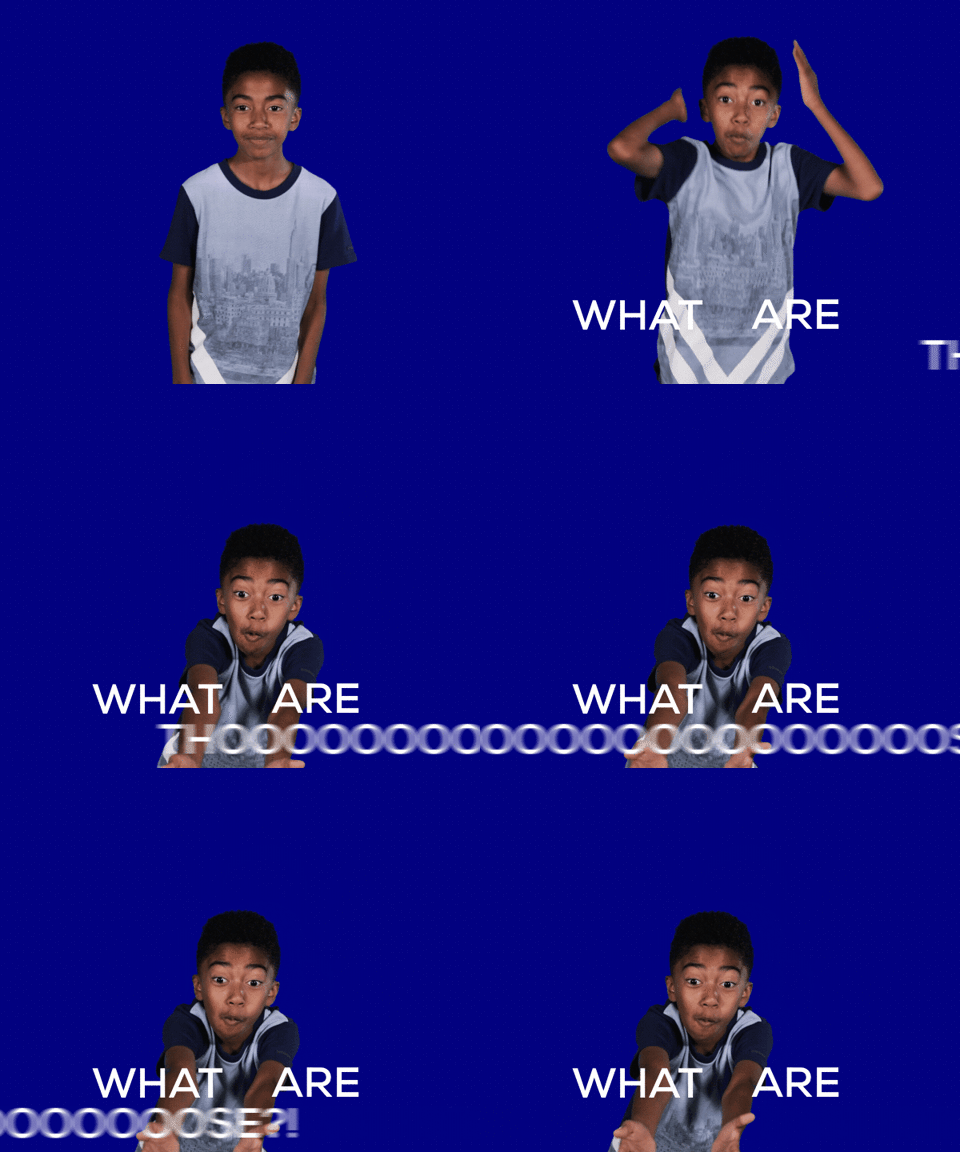
Great question.
The simplest explanation is that in music, the breaks are the moment when an instrument drops. For example when Clyde Stubblefield, James Brown’s drummer, plays on the breaks in this song Funky Drummer (around 5:26), the guitar drops and the drummer keeps playing. These are the breaks:
This musical moment is not a “concept.” Rather it gives expression to an experience built into the very fabric of human existence: the downs, unexpected blows, sudden drops, and unpredictably spontaneous gaps in what you thought you knew about this life. These breaks simultaneously destroy our sense of an individualized self and puts us in touch with the Great Mystery of the life-death-life cycle inherent in all being.
This moment is recounted in all great world myths which reflect and express patterns found in material reality.
When Kore is taken to the underworld, this is a break. When West Africans are taken captive and brought to North America via the Atlantic Slave Trade, this is a break. When The Fool in the Tarot walks off the cliff, this is a break.
Murray notes that the capacity to play on (or through) these moments is a kind of surrender to the transformative, initiatory process, and this initiatory process is both fundamental to what it means to be human and essential to the endurance of the human spirit. It is also the ritual foundation from which all elite art forms spring.
Duke Ellington and Ella Fitzgerald’s famous song perfectly captures this orientation:
“It don’t mean a thing if it ain’t got that swing.”
The line “makes no difference if its sweet or hot; give that rhythm everything you’ve got” brings tears to my eyes now. It means something completely different than what it meant when I first heard this song, or even when I first studied Albert Murray. It is one thing to know the breaks in an abstract, philosophical sense. It is another thing entirely to know it in your bones through lived experience.
Maybe this is why Kurtis Blow’s The Breaks, was the first rap song to sell one million copies and be certified gold by the Recording Industry Association of America. Ironically, it’s a song my mom used to sing to me when I was a child, almost as if she was unconsciously warning me about my future.
Here are a few lines:
If your woman steps out with another man
(That's the breaks, that's the breaks)

And she runs off with him to Japan
(That's the breaks, that's the breaks)

And the IRS says they wanna chat
(That's the breaks, that's the breaks)

And you can't explain why you claimed your cat
(That's the breaks, that's the breaks)
The breaks are the trials and tribulations that shape us, dissolve us, and remake us: A loved one suddenly dies; you lose all your money in a bad investment; you tell your parents you’re gay and they disown you.
These are the breaks. They are the initiatory “briarpatch” as Murray put it, the thicket of thorns and prickly plants that put you in touch with the mortality at the center of existence. They are meant to demolish you and reweave you into proper relationality with the cosmos. These are the encounters that the human being must pass through in order to transition from adolescence to adulthood and return to the community with the wisdom pruned from the nectar of her experience.
This process is excruciatingly uncomfortable but it is also a direct education on what it means to be human. In order to come into the fullness of who you are, you must go through a death process, be dismantled, and be regrown.
Our human condition is cyclical like the Moon. We are born wide eyed and bushy tailed but we cannot stay in this pristine, Edenic state. Adulthood requires confrontation with Winter, with death, both in a literal sense at the end of our lives and through the dissolving of our egos at the varying stages we pass through while we are still living.
Mother. Maiden. Crone. These are the many faces of the Goddess. There are breaks in between. This is life’s orchestral cycle. And if communally and ritualistically enacted through art forms like musical composition, writing, dance, and storytelling, Kore is transformed into Persephone who then calls Spring forth from Winter and makes creativity possible.
Murray asks us to say yes! to this journey and to affirm this journey, despite the fact that it is painful and will ultimately leave us undone.
I have always been an incredible dancer and I’ve yearned to marry my artistic sensitivities to my intellectual mind. I am starting to now see how my experience of sorrow and grief in the face of my parent’s decision to cut ties with me is a break, a “ceasura”, inviting me to dance.
Will you join me?
My Offerings This Month
How To Sing Workshop - Monday, July 6th, 7 - 9pm.
I’m running another virtual How to Sing workshop in two weeks. Tell your friends to come. Get your tickets here.
Inner Light Counseling
I have a few more open spots if you’d like to get some one-on-one coaching. We chat once a week and I recommend art based practices and modalities based on what you’re going through in life. These are practices that will help you deepen your relationships with yourself, others, and our beautiful planet. Respond to this via the comment section or email me at info@theoryofenchantment.com if you’re interested!
4th of July Afrohouse Party 🗽
If you’re in New York for the 4th of July, join me and DJ Spyon at Acoustik Garden in Brooklyn for an Afrohouse themed day party. You can get your tickets here.